


My client projects fell apart the week I got sick. Everything waited for me to get back. I realized I wasn’t running a business.
So I did what most business owners do. You hit a breaking point. You delegate. You hire a team. You spend time training them. Eventually, they leave. Then you start over with someone new.
But the output is inconsistent. So now you’re approving work, fixing mistakes, and answering questions. When something breaks, it comes back to you.
You try outsourcing. But you’re just one of many manilla folders on a desk. Agencies don’t know your business like you do. They split their attention. They work on their schedule. Not yours. You still end up managing them. Or hiring someone to manage them.
Instead of getting out of the grind you are buried deeper in it. You genuinely tried to delegate. But when delegation becomes another job. Now you have yet another hat to wear.
Again.
When the Business Depends on You, It Owns You.
Have you ever heard the phrase, “If you want it done right . . . “
You know how it ends. Most small business owners are the key employee in the business.
You’re the one clients trust. The one who knows how things work. The one who can’t step away without something slipping. Your time and attention are the limit. If you’re not involved, things slow down. If you leave, they stop.
The business doesn’t run without you. Because it _is_ you.
It’s a trap.

This simple framework is how I see the trap more clearly. Because [[POST - once you can see the problem you can solve the problem]].
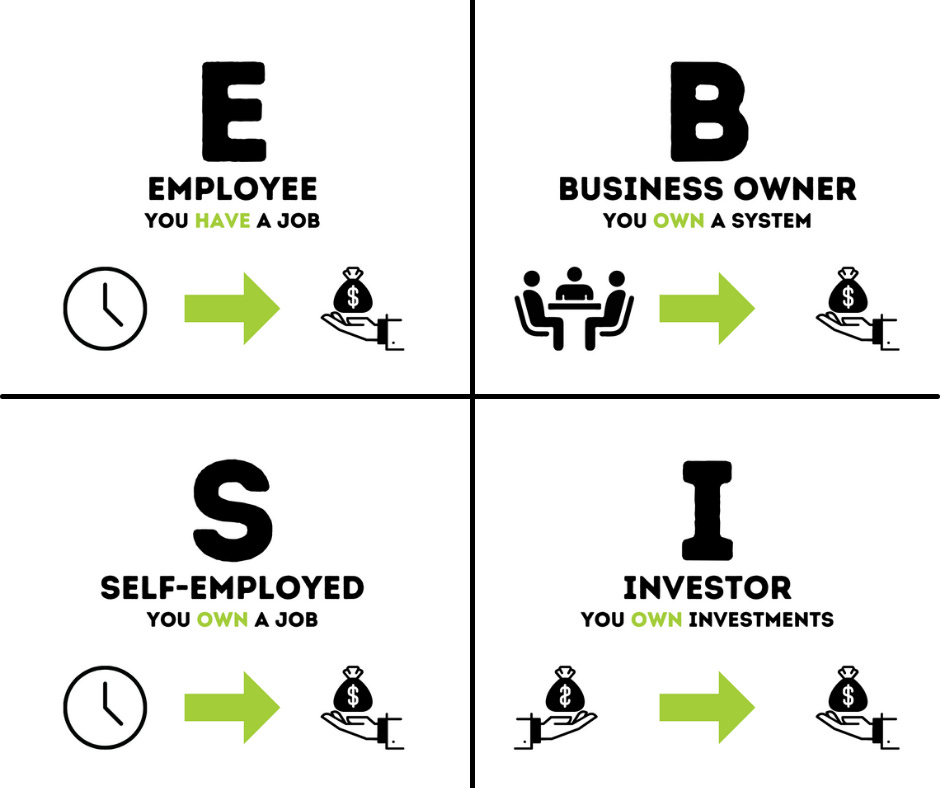
The Cashflow Quadrant breaks down how people earn income into two main groups: those who trade time for money, and those who own assets that generate income. On the left, you have Employees and Self-Employed professionals. Both groups rely on their own effort to earn. On the right, you have Owners. Business Owners build systems that generate revenue; As an investor they buy into someone else’s business. Two sides of the same coin: income from assets, not effort.
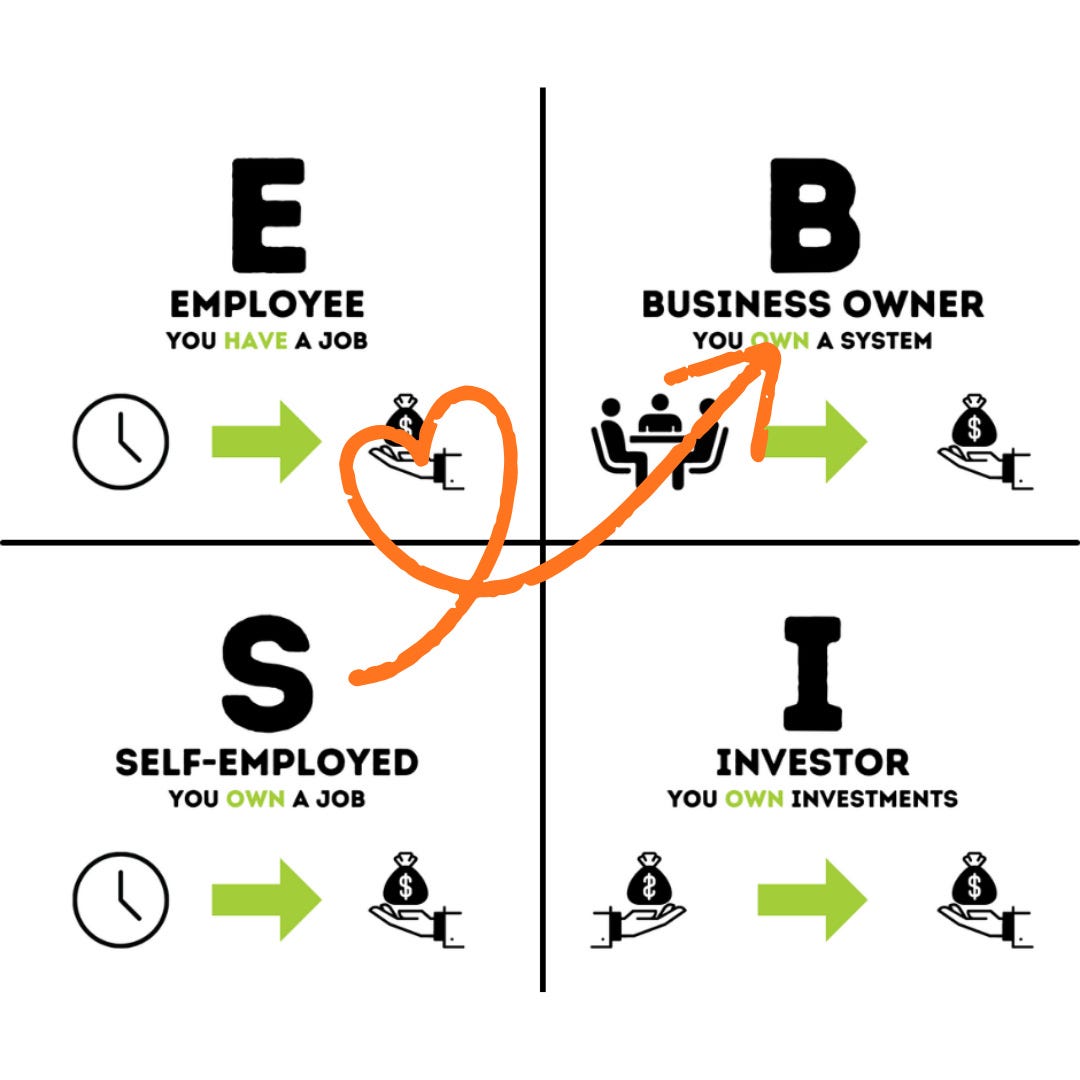
Most small business owners think they’re in the B quadrant: Business Owner. But they’re actually stuck in S quadrant: Self-Employed.
In the S quadrant, you own your job. Your income depends on your time. Your freedom doesn’t grow with your revenue. You might have a team, systems, even an office. But if everything still runs through you, you are ultimately trading your time for money.
In the B quadrant, the business works without you. It creates value, captures it, and delivers. Without your daily effort. It is a system.
Most businesses that look like a business are actually just high-paying jobs with overhead.
How I move from owning a job to owning a business.
I make things crystal clear. Because clarity is leverage.
A business solves a problem for profit. More specifically a business is a repeatable process, or a collection of processes, that creates and delivers value to customers at a price they will pay, while ensuring it generates enough profit to be worthwhile for the owner(s). This breaks down into five core functions: value creation, marketing, sales, value delivery, and finance.
But, can you really own a process? Absolutely.
Clarity about what a business is lets you redefine it from something you are, to something you own. An asset.
What is an Asset?
The answer seems obvious. But let’s take my one question pop quiz and find out.
Thought experiment: Is your house an asset?

Most accountants would say yes. But ask yourself:
Does it put money in your pocket?
Or does it take money out?
That’s the test.
If it doesn’t generate income, it’s not an asset.
It’s a liability disguised as an asset.
But you can sell the house for money? And you will make money when you sell it? The fact that something _might_ appreciate or be resold later doesn’t make it an asset. It’s a speculative investment.
But I’m less interested in changing your mind on this one point in favor of changing your mindset.
Most small businesses don’t build real assets.
They build obligations.
Payroll. Client work. Meetings. Approvals. Fires to put out.
They build workflows, mostly for themselves.
The result?
More revenue. More responsibility.
No leverage. No ownership. No escape.
How do I move from owning a job to owning a business? By seeing my business as primarily being in the business of owning assets.
My business owns hard assets, property, equipment, etc. But it also owns workflows that deliver value to customers at a price they are willing to pay that generates enough profit to be worthwhile for me.
Delegation Itself Isn’t Leverage
Most business owners hit a breaking point. So they delegate.
Been there. Done that. Got the tee-shirt. We are back to the beginning of this article.
But now you can see the trap. The Cashflow Quadrant let’s you see the picture more clearly. Lets go deeper. Here are two more frameworks that will end the cycle.
Two foundational models define how your business works:
1. The Business Model — What you promise
2. The Operating Model — How you deliver
Refer back to the five core functions of a business, value delivery and marketing comprise the business model, your marketing is literally what you promise. Value delivery (operations or customer service), sales, and finance comprise the operating model.
But to keep things simple. Simple and clear.
The business model is what you promise.
The operating model is how you deliver on your promise.
When these models are vague, delegation collapses into micromanagement. When they are clear, people and systems can actually own outcomes.
Clarity lets you stop being the system.
And start building one that works without you.
How I Can Help
I move workflows from the business and operating models into a technology model.
An asset you own that delivers your value through your workflows.
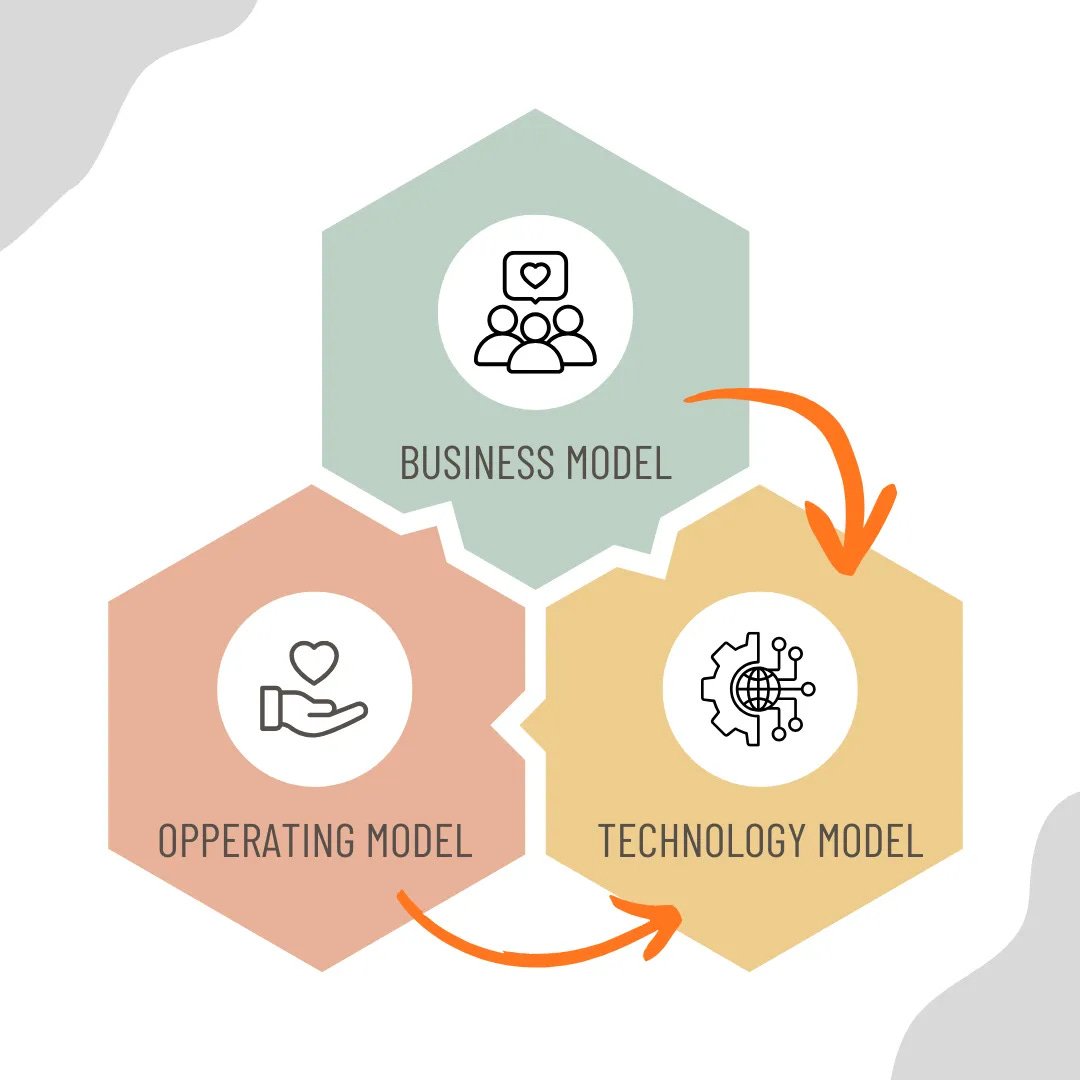
Instead of feeling clear, you might be feeling a little overloaded. Why? Because there is a lot going on in each of those models. And baked into both models, always present, but never named, is technology.
Because technology is a tool. Tools are paired with people.
At least until now.
Now technology can become a separate workflow.
From tool… to Technology Model.
I help you design your business so it doesn’t rely on heroic effort. Mostly your own.
Here’s what that unlocks:
Moving workflows from the Business Model to the Technology Model:
Delivers services at larger scale
Adds new revenue streams
Extends offerings
Moving workflows from the Operating Model to the Technology Model:
Increase consistency, traceability, and speed
Automate core workflows
Lower delivery cost
My role is to help you discover opportunities to move workflows from your business and operations models into your technology model.
You are Closer Than You Think
Most of what you need already exists in your business: your systems, your workflows, your judgment. The work now is to turn what you _do_ into something your business owns.
I can help you with that.
Let’s explore how to make your business run on assets, not effort.
No pitch. No pressure. Just a strategic conversation about where opportunities exist.
References & Further Reading
Gerber, Michael E. _The E-Myth Revisited: Why Most Small Businesses Don’t Work and What to Do About It_. New York: HarperBusiness, 1995.
Kaufman, Josh. _The Personal MBA: Master the Art of Business_. New York: Portfolio/Penguin, 2010.
Kiyosaki, Robert T. _Rich Dad’s Cashflow Quadrant: Guide to Financial Freedom_. New York: Warner Business Books, 2000.
Vashishta, Vin. From Data to Profit: How Businesses Leverage Data to Grow Their Top and Bottom Lines. Hoboken, NJ: Wiley, 2023